Friday, June 4, 2010

Saint Philomena: Patron of The Living Rosary

Portrait of St. Philomena commissioned by St. John Vianney.

Saint Philomena is venerated as a virgin martyr saint of the Catholic Church, said to have been a young Greek princess martyred in the 4th century. Her veneration  began in the early 19th century after the archaeological  discovery in the Catacombs of Priscilla of the bones of a young woman, which were interpreted as those of a martyr. Nothing else was known about her, but an inscription found at the tomb was taken to indicate that her name was (in the Latin of the inscription) Filumena; corresponding to the English name Philomena.

The remains were removed to Mugnano del Cardinale in 1805 and became the focus of widespread devotion, with several miracles credited to the saint's intercession, including the healing of Venerable Pauline Jaricot in 1835, which received wide publicity. Saint Jean Vianney attributed to her intercession the extraordinary cures that others attributed to himself. Accounts of her life and martyrdom circulated on the basis of visions of a Neapolitan nun.

Her liturgical celebration was never included in the General Roman Calendar for universal use, but, beginning in 1837, it was approved for some places. The 1920 typical edition of the Roman Missal included a mention of her, under August 11, in the section headed Missae pro aliquibus locis (Masses for some places), with an indication that the Mass to be used in those places was one from the common of a Virgin Martyr, without any collect proper to the saint. On 14 February 1961, the Holy See ordered that the name of Saint Philomena be removed from all liturgical calendars that mentioned her. Accordingly, the 1962 Roman Missal, the edition whose continued use as an extraordinary form of the Roman Rite is authorized by the motu proprio Summorum Pontificum, also has no mention of her.

Discovery of The Remains

On 24 May 1802 in the Catacombs of Priscilla on the Via Salaria Nova an inscribed loculus (space hollowed out of the rock) was found, and on the following day it was carefully examined and opened. The loculus was closed with three terra cotta tiles, on which was the following inscription: lumena paxte cumfi. It was and is generally accepted that the tiles were in a wrong order and that the inscription originally read, with the leftmost tile placed on the right: pax tecum Filumena (i.e."Peace with you, Philomena"). Within the loculus was found the skeleton of a female between thirteen and fifteen years old. Embedded in the cement was a small glass phial with vestiges of what was taken to be blood. In accordance with the assumptions of the time, the remains were taken to be those of a virgin martyr named Philomena.

The belief that such vials were signs of the grave of a martyr was still held in 1863, when a 10 December decree of the Sacred Congregation of Rites confirmed a decree of 10 April 1668.  But this view has been rejected in practice since the investigations of Giovanni Battista De Rossi (1822-1894).


Shrine to St. Philomena inside the church at Mugnano del Cardinale, Italy


In 1805, Canon Francesco De Lucia requested relics for a new altar, and on 8 June obtained the remains discovered in May 1802 (reduced to dust and fragments) for his church in Mugnano del Cardinale , where they arrived on 11 August, after being taken from Rome to Naples on 1 July.  In 1827, Pope Leo XII gave to the church in Mugnano del Cardinale the three inscribed terra cotta slabs that had been taken from the tomb.

Church of Saint Philomena in Mugnano del Cardinale, Italy

Reported Life of Saint Philomena

On 21 December 1833, the Holy Office declared that there was nothing contrary to the Catholic faith in the revelations that Sister Maria Luisa di Gesù (1799-1875), a Dominican tertiary from Naples, claimed to have received from the Saint herself.

According to Sister Maria Luisa di Gesù, Saint Philomena told her she was the daughter of a king in Greece who, with his wife, had converted to Christianity. At the age of about 13 she took a vow of consecrated virginity. When the Emperor Diocletian threatened to make war on her father, he went with his family to Rome to ask for peace. The Emperor fell in love with the young Philomena and, when she refused to be his wife, he subjected her to a series of torments: scourging, from whose effects two angels cured her; drowning with an anchor attached to her, but two angels cut the rope and raised her to the river bank; being shot with arrows, but on the first occasion her wounds were healed, on the second the arrows turned aside, and on the third, they returned and killed six of the archers, and several of the others became Christians. Finally the Emperor had her decapitated, which occurred on a Friday at three in the afternoon, as with the death of Jesus. The two anchors, three arrows, the palm and the ivy leaf on the tiles found in the tomb were interpreted as symbols of her martyrdom.

In these visions she also revealed that her birthday was 10 January, that her martyrdom occurred on 10 August (the date also of the arrival of her relics in Mugnano del Cardinale), and that her name "Filumena" meant "daughter of light". (It is usually taken to be derived from a Greek word meaning "beloved".)

For prayers to Saint Philomena, including her rosary chaplet,  please click here.

Article taken from Wikipedia.

La Virgen de la Caridad del Cobre - The Virgin of Charity

La Virgen de la Caridad del Cobre

La Virgen de La Caridad del Cobre
"The Virgin of Charity"

The Virgin of Charity (La Virgen de la Caridad) is a miraculous statue of the Virgin Mary in the mining town of El Cobre, outside Santiago in southwest Cuba. Her shrine is the most important religious site on the entire island.

A focus of intese popular devotion—not just for Catholics but also for followers of Santería and even those who aren't otherwise religious—the beloved Virgin of Charity was declared the patron saint of Cuba by the pope in 1916. 

History

The town of El Cobre was founded in 1550 as a Spanish copper mine, worked by slaves and Indians. One day in 1608, two Indians and a slave boy were gathering salt on the coast near El Cobre when they saw something floating in the water. It was a small statue of the Virgin Mary, carrying the Christ child and a gold cross. She floated on a board bearing the inscription, Yo soy la Virgen de la Caridad, "I am the Virgin of Charity."

At the time, the church in El Cobre was dedicated to Santiago, St. James, the powerful patron of the Spanish conquest. So the statue of the Virgin was placed in a thatched hut instead of in the church. But on three successive nights, the statue disappeared from the hut and was found on top of the hill above El Cobre.


Statue of the Virgin of Charity in the El Cobre Basilica, Santiago, Cuba


The Virgin of Charity resided in several small shrines until 1630, when the copper mine was closed and the slaves were freed. She then took St. James' place above the high altar in the church, a symbol of the triumph of the people over the Spanish conquerers.

Since then, the Virgin has continued to assist her people and has been credited with countless miracles. In 1731, when an attempt was made to reintroduce slavery, she became a symbol of emancipation for one of Cuba's largest slave insurrections. In the end, the slaves were declared free. This spread devotion to Our Lady of Charity even further.

In 1916, the pope visited the shrine of the Virgin of Charity and declared her the patron saint of Cuba. El Cobre Basilica was built to house her in 1927. In 1998, Pope John Paul II crowned her statue during his historic visit to communist Cuba.

The Virgin has collected many votive offerings from her grateful worshippers over the years. In the 1950s, Ernest Hemingway  gave the Virgin the Nobel Prize for Literature he won after writing The Old Man and the Sea in Havana. The mother of Fidel and Raul Castro  left a small golden guerrilla fighter at the feet of the Virgin as her sons battled the government of dictator Fulgencio Batista ahead of the Cuban Revolution.

Today, the Virgin of Charity in El Cobre continues to receive streams of visitors and stacks of votive gifts. Common objects left in more recent times include replicas of rafts, representing safe journeys to America, and photos of activists who have been imprisoned by Castro's government.


El Cobre Basilica, Santiago, Cuba

Prayer to Our Lady of Charity, Patroness of Cuba

Most Holy Mother of Charity
who came to us as a messenger of peace across the sea.
You are the Mother of all Cubans
To you we come, Most Holy Mother of God
to honor you with love as your children.
To your motherly heart
we entrust our desires and hopes
our work and our prayers.
We pray for our torn country
that we may be able to build
a nation based on peace and unity.
We pray for our families
that they may live in fidelity and love.

We pray for our children
that they may grow strong
in spirit and in body.

We pray for our young people
that their faith may increase,
as well as their attachment to
the truth.

We pray for the sick, the homeless,
the lonely, the exiled,
and for all suffering souls.
We pray for the Catholic Church in Cuba,
for its mission,
for its priests, deacons,
religious and laity.

We pray for the victory
of justice and love
in our country.

Mother of Charity!
We place ourselves
under your mantle of protection!
Blessed are you among women
and blessed is the fruit of your womb, Jesus!
And to Him be the glory and the power
now and forever. Amen. 


Source: http://www.sacred-destinations.com/cuba/el-cobre.htm

Sunday, May 30, 2010

Our Lady of Olives

Our Lady of Olives

In a pleasant valley of France there lies a little city where, by the favor of God, lightning never falls.  This favor, unique in the world, dates back to the time when the church of Murat (Cantal) was burned by lightning except for a wooden statue of the Virgin Mary.  In 1493, and ever since, the town has been named Our Lady of Olives.  The Virgin Mary is the Olive recalled in the scriptures (Sirach 24:14).


By virtue of the Medallion of Our Lady of Olives, the persons who carry it are preserved from lightning wherever they may be during a storm.  It is a privilege attached to the medallion which bears the unique name in the annals of the church, "Our Lady of Olives."  This marvelous way of being protected against lightning deserves to be known throughout the world and ought to be extended to the four corners of the universe.

The second privilege of the Medallion is to protect, in an unmistakable manner, women who are about to become mothers and to assist them in the hour of deliverance.  

Those who are afflicted with sickness and who pray to the Divine Mother, are promptly relieved.

The Virgin was crowned June 18, 1881, by an apostolic brief given by Leo XIII on the tenth day of May 1878.

Our Lady of the Olives Basilica of Our Lady of the Sea Barcelona, Spain


 Prayer to Our Lady of Olives

Kneeling at thy feet, we pray thee Virgin Mary, that through thine intercession, there may be borne a new generation who will unite all hearts and souls in the same faith and the same charity.

We pray thee "Divine Olive of Peace," to implore God that harmony may reign between nations, that true liberty be given to all people, that heresies and all bad doctrines condemned by the Pope may disappear.

We pray that all the treasures of the Divine Heart be showered upon all men and that we be preserved from all harm.

Pray for us, help us and save us. Amen.
Source: JMJ Book Company Catalog, p. 158

Friday, May 7, 2010

Saint Catherine of Siena

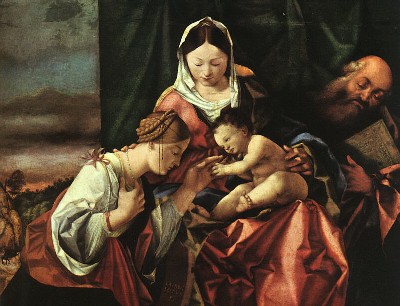
The Mystic Marriage of Saint Catherine
Lorenzo Lotto 1506-07

Saint Catherine of Siena
1347 - 1380
Doctor of the Church


Patronage: Italy, Europe,  Fire Prevention, Illness, Miscarriages, Nursing and Nurses
Feast Day: 29 April (formerly 30 April)
Canonized: July 1641 by Pope Pius II

The Middle Ages were drawing to a close and the brave new world of the Renaissance was springing to life when Catherine Benincasa was born. The place was Siena, and the day was the feast of the Annunciation, 1347. Catherine and a twin sister who did not long survive were the youngest of twenty-five children. The father, Giacomo or Jacopo Benincasa, a prosperous wool dyer, lived with his wife Lapa and their family, sometimes comprising married couples and grandchildren, in a spacious house which the Sienese have preserved to the present day. 

As a child Catherine was so merry that the family gave her the pet name of Euphrosyne, which is Greek for Joy and also the name of an early Christian saint. At the age of six she had the remarkable experience which may be said to have determined her vocation. With her brother she was on the way home from a visit to a married sister, when suddenly she stopped still in the road, gazing up into the sky. She did not hear the repeated calls of the boy, who had walked on ahead. Only after he had gone back and seized her by the hand did she wake as from a dream. She burst into tears. Her vision of Christ seated in glory with the Apostles Peter, Paul, and John had faded. A year later the little girl made a secret vow to give her whole life to God. She loved prayer and solitude, and when she mingled with other children it was to teach them to do what gave her so much happiness. 

When Catherine was twelve, her mother, with marriage in mind, began to urge her to pay more attention to her appearance. To please her mother and sister, she dressed in the bright gowns and jewels that were fashionable for young girls. Soon she repented of this vanity, and declared with finality that she would never marry. When her parents persisted in their talk about finding her a husband, she cut off the golden-brown hair that was her chief beauty As punishment, she was now made to do menial work in the household, and the family, knowing she craved solitude, never allowed her to be alone. Catherine bore all this with sweetness and patience. Long afterward, in "The Dialogue", she wrote that God had shown her how to build in her soul a private cell where no tribulation could enter.

Catherine's father at last came to the realization that further pressure was useless, and his daughter was permitted to do as she pleased. In the small, dimly-lighted room now set apart for her use, a cell nine feet by three, she gave herself up to prayers and fasting; she scourged herself three times daily with an iron chain, and slept on a board. At first she wore a hair shirt, subsequently replacing it by an iron-spiked girdle. Soon she obtained what she ardently desired, permission to assume the black habit of a Dominican tertiary, which was customarily granted only to matrons or widows. She now increased her asceticism, eating and sleeping very little. For three years she spoke only to her confessor and never went out except to the neighboring church of St. Dominic, where the pillar against which she used to lean is still pointed out to visitors.

At times now she was enraptured by celestial visions, but often too she was subjected to severe trials. Loathsome forms and enticing figures would present themselves to her imagination, and the most degrading temptations assailed her. There would be long intervals during which she felt abandoned by God. "O Lord, where wert Thou when my heart was so sorely vexed with foul and hateful temptations?" she asked, when after such a time of agonizing He had once more manifested Himself. She heard a voice saying, "Daughter, I was in thy heart, fortifying thee by grace," and the voice then said that God would now be with her more openly, for the period of probation was nearing an end.

On Shrove Tuesday, 1366, while the citizens of Siena were keeping carnival, and Catherine was praying in her room, a vision of Christ appeared, accompanied by His mother and the heavenly host. Taking the girl's hand, Our Lady held it up to Christ, who placed a ring upon it and espoused her to Himself, bidding her to be of good courage, for now she was armed with a faith that could overcome all temptations. To Catherine the ring was always visible, though invisible to others. The years of solitude and preparation were ended and soon afterward she began to mix with her fellow men and learn to serve them. Like other Dominican tertiaries, she volunteered to nurse the sick in the city hospitals, choosing those afflicted with loathsome diseases—cases from which others were apt to shrink.

There gathered around this strong personality a band of earnest associates. Prominent among them were her two Dominican confessors, Thomas della Fonte and Bartholomew Dominici, the Augustinian Father Tantucci, Matthew Cenni, rector of the Misericordia Hospital, the artist Vanni, to whom we are indebted for a famous portrait of Catherine, the poet Neri di Landoccio dei Pagliaresi, her own sister-in-law Lisa, a noble young widow, Alessia Saracini, and William Flete, the English hermit. Father Santi, an aged hermit, abandoned his solitude to be near her, because, he said, he found greater peace of mind and progress in virtue by following her than he ever found in his cell. A warm affection bound her to these whom she called her spiritual family, children given her by God that she might help them along the way to perfection. She read their thoughts and frequently knew their temptations when they were away from her. Many of her early letters were written to one or another of them.

At this time public opinion about Catherine was divided; many Sienese revered her as a saint, while others called her a fanatic or denounced her as a hypocrite. Perhaps as a result of charges made against her, she was summoned to Florence to appear before the general chapter of the Dominicans. Whatever the charges were, they were completely disproved, and shortly afterwards the new lector for the order in Siena, Raymund de Capua, was appointed her confessor. In this happy association, Father Raymund was in many things of the spirit her disciple. Later he became the saint's biographer.

After Catherine's return to Siena there was a terrible outbreak of the plague, during which she and her circle worked incessantly to relieve the sufferers. "Never did she appear more admirable than at this time," wrote a priest who had known her from girlhood. "She was always with the plague-stricken; she prepared them for death and buried them with her own hands. I myself witnessed the joy with which she nursed them and the wonderful efficacy of her words, which brought about many conversions." Among those who owed their recovery directly to her were Raymund of Capua himself, Matthew Cenni, Father Santi, and Father Bartholomew, all of whom contracted the disease through tending others. Her pity for dying men was not confined to those who were sick. She made it a practice to visit condemned persons in prison, hoping to persuade them to make their peace with God. On one occasion she walked to the scaffold with a young Perugian knight, sentenced to death for using seditious language against the government of Siena. His last words were: "Jesus and Catherine! "

Her deeds of mercy, coupled with a growing reputation as a worker of miracles, now caused the Sienese to turn to Catherine in all kinds of difficulties. Three Dominican priests were especially deputed to hear the confessions of those whom she had prevailed on to amend their lives. In settling disputes and healing old feuds she was so successful that she was constantly called upon to arbitrate at a time when all through Italy every man's hand seemed to be against his neighbor. It was partly, perhaps, with a view to turning the energies of Christendom away from civil wars that Catherine threw herself into Pope Gregory's campaign for another crusade to wrest the Holy Sepulchre from the Turks. This brought her into correspondence with Gregory himself.

In February, 1375, she accepted an invitation to visit Pisa, where she was welcomed with enthusiasm. She had been there only a few days when she had another of the spiritual experiences which seem to have presaged each new step in her career. She had made her Communion in the little church of St. Christina, and had been gazing at the crucifix, when suddenly there descended from it five blood-red rays which pierced her hands, feet and heart, causing such acute pain that she swooned. The wounds remained as stigmata, visible to herself alone during her life, but clearly to be seen after her death.

She was still in Pisa when she received word that the people of Florence and Perugia had entered into a league against the Holy See and the French legates. The disturbance had begun in Florence, where the Guelphs and the Ghibellines united to raise a large army under the banner of freedom from the Pope's control, and Bologna, Viterbo, and Ancona, together with other strongholds in the papal domain, rallied to the insurgents. Through Catherine's untiring efforts, the cities of Lucca, Pisa, and Siena held back. From Avignon, meanwhile, after an unsuccessful appeal to the Florentines, the Pope, Gregory XI, sent Cardinal Robert of Geneva with an army to put down the uprising, and laid Florence under an interdict. The effects of the ban on the life and prosperity of the city were so serious that its rulers sent to Siena, to ask Catherine to mediate with the Pope. Always ready to act as a peacemaker, she promptly set out for Florence. The city's magistrates met her as she drew near the gates, and placed the negotiations entirely in her hands, saying that their ambassadors would follow her to Avignon and confirm whatever she did there. Catherine arrived in Avignon on June 18, 1376, and was graciously received by the Pope. "I desire nothing but peace," he said; "I place the affair entirely in your hands, only I recommend to you the honor of the Church." As it happened, the Florentines proved untrustworthy and continued their intrigues to draw the rest of Italy away from allegiance to the Holy See. When their ambassadors arrived, they disclaimed all connection with Catherine, making it clear by their demands that they did not desire a reconciliation.

Although she had failed in this matter, her efforts in another direction were successful. Many of the troubles which then afflicted Europe were, to some degree at least, due to the seventy-four-year residence of the popes at Avignon, where the Curia was now largely French. Gregory had been ready to go back to Rome with his court, but the opposition of the French cardinals had deterred him. Since in her letters Catherine had urged his return so strongly, it was natural that they should discuss the subject now that they were face to face. "Fulfill what you have promised," she said, reminding him of a vow he had once taken and had never disclosed to any human being. Greatly impressed by what he regarded as a supernatural sign, Gregory resolved to act upon it at once.
 
On September 13, 1376, he set out from Avignon to travel by water to Rome, while Catherine and her friends left the city on the same day to return overland to Siena. On reaching Genoa she was detained by the illness of two of her secretaries, Neri di Landoccio and Stephen Maconi. The latter was a young Sienese nobleman, recently converted, who had become an ardent follower. When Catherine got back to Siena, she kept on writing the Pope, entreating him to labor for peace. At his request she went again to Florence, still rent by factions, and stayed there for some time, frequently in danger of her life. She did finally establish peace between the city governors and the papacy, but this was in the reign of Gregory's successor.

After Catherine returned to Siena, Raymund of Capua tells us, "she occupied herself actively in the composition of a book which she dictated under the inspiration of the Holy Ghost." This was the mystical work, in four treatises, called "The Dialogue of St. Catherine". Her health was now so impaired by austerities that she was never free from pain; yet her thin face was usually smiling. She was grieved by any sort of scandal in the Church, especially that of the Great Schism which followed the death of Gregory XI. Urban VI was elected as his successor by the cardinals of Rome and Clement VII by the rebellious cardinals of Avignon. Western Christendom was divided; Clement was recognized by France, Spain, Scotland, and Naples; Urban by most of North Italy, England, Flanders, and Hungary. Catherine wore herself out trying to heal this terrible breach in Christian unity and to obtain for Urban the obedience due to the legitimate head. Letter after letter was dispatched to the princes and leaders of Europe. To Urban himself she wrote to warn him to control his harsh and arrogant temper. This was the second pope she had counseled, chided, even commanded. Far from resenting reproof, Urban summoned her to Rome that he might profit by her advice. Reluctantly she left Siena to live in the Holy City. She had achieved a remarkable position for a woman of her time. On various occasions at Siena, Avignon, and Genoa, learned theologians had questioned her and had been humbled by the wisdom of her replies.

Although Catherine was only thirty-three, her life was now nearing its close. On April 21, 1380, a paralytic stroke made her helpless from the waist downwards, and eight days later she passed away in the arms of her cherished friend, Alessia Saracini. The Dominicans at Rome still treasure the body of Catherine in the Minerva Church, but Siena has her head enshrined in St. Dominic's Church. Pope Pius II canonized Catherine in 1461.

- Taken from Lives of Saints, Published by John J. Crawley & Co., Inc.

Friday, March 19, 2010

Chaplet of Our Lady Star of The Sea "Stella Maris"

Stella Maris - Our Lady Star Of The Sea

Our Lady, Star of the Sea, Stella Maris, is the Patroness of the men who sail the seas. Saint Bonaventure reminds us that She also "guides to a landfall in heaven those who navigate the sea of this world in the ship of innocence or penance."  

Ships at sea might be guided by the North Star.  Our Lady, Star of the Sea, aids not only the sailors aboard those ships, She also aids all those who sail the stormy seas of life.

The Our Lady Star of the Sea chaplet consists of fifteen beads, a rosary center and a Stella Maris medal.

The Medal Prayer:  A Prayer to the Blessed Virgin
Most beautiful Flower of Mount Carmel, Fruitful Vine, Splendor of Heaven, Blessed Mother of the Son of God, Immaculate Virgin, assist me in this my necessity.  O Star of the Sea, help me and show me herein you are my Mother.

Holy Mary, Mother of God, Queen of Heaven and Earth, I humbly beseech you from the bottom of my heart, to succor me in this necessity; there are none that can withstand your power.

First Three Beads:
One Our Father, one Hail Mary, one Glory Be on each of the three beads for Bishop Warren Boudreaux, Pope John Paul II and Father John Paul Finke.

On Each of the Twelve Beads, Which represent the 12 Stars of Our Lady's Crown, Pray:
One Hail Mary on each bead and the following invocations:

Our Lady, Star of the Sea, Help and Protect us!  Sweet Mother, I place this cause in your hands.

If you'd like to  read more about Our Lady, Star of the Sea, wikipedia has an excellent article.

My Treasury of Chaplets Eighth, Enlarged Edition by Patricia S. Quintiliani


Monday, February 8, 2010

Saint Therese of Lisieux "The Little Flower"


Saint Therese of Lisieux, "The Little Flower"
 1873 - 1897

Carmelite of Lisieux, better known as the Little Flower of Jesus, born at Alençon, France, 2 January, 1873; died at Lisieux 30 September, 1897.

She was the ninth child of saintly parents, Louis and Zélie Martin, both of whom had wished to consecrate their lives to God in the cloister. The vocation denied them was given to their children, five of whom became religious, one to the Visitation Order and four in the Carmelite Convent of Lisieux. Brought up in an atmosphere of faith where every virtue and aspiration were carefully nurtured and developed, her vocation manifested itself when she was still only a child.

 
Little Therese Martin


Educated by the Benedictines, when she was fifteen she applied for permission to enter the Carmelite Convent, and being refused by the superior, went to Rome with her father, as eager to give her to God as she was to give herself, to seek the consent of the Holy Father, Leo XIII, then celebrating his jubilee. He preferred to leave the decision in the hands of the superior, who finally consented and on 9 April, 1888, at the unusual age of fifteen, Thérèse Martin entered the convent of Lisieux where two of her sisters had preceded her.


She was given the habit and received the name: Thérèse of the Child Jesus. On 8 September 1890 Thérèse took her vows; the ceremony of taking the veil followed on the 24th when she added to her name in religion, "and of the Holy Face", a title which was to become increasingly important in the development and character of her inner life. In her poem "My Heaven down here" composed in 1895 she expressed the notion that by the divine union of love, the soul takes on the semblance of Christ. By contemplating the sufferings associated with the Holy Face of Jesus, she felt she could become closer to Christ.


Thérèse's final years were marked by a steady decline that she bore resolutely and without complaint. Tuberculosis was the key element of Therese's final suffering, but she saw that as part of her spiritual journey. After observing a rigorous Lenten fast in 1896, she went to bed on the eve of Good Friday and felt a joyous sensation. She wrote: "Oh! how sweet this memory really is!... I had scarcely laid my head upon the pillow when I felt something like a bubbling stream mounting to my lips. I didn't know what it was".

The next morning she found blood on her handkerchief and understood her fate. Coughing up of blood meant tuberculosis and tuberculosis meant death. She wrote:

"I thought immediately of the joyful thing that I had to learn, so I went over to the window. I was able to see that I was not mistaken. Ah! my soul was filled with a great consolation; I was interiorly persuaded that Jesus, on the anniversary of His own death, wanted to have me hear His first call!"

Thérèse corresponded with a Carmelite mission in what was then French Indochina, and was invited to join them, but, because of her sickness, could not travel. In July 1897 she made a final move to the monastery infirmary, where she died on 30 September 1897, at the young age of 24. On her death-bed, she is reported to have said:

 "I have reached the point of not being able to suffer any more, because all suffering is sweet to me."

Thérèse was buried in the Carmelite plot in the municipal cemetery at Lisieux, where Louis and Zelie had been buried. However in March 1923, before she was beatified, her body was returned to the Carmel of Lisieux, where it remains.


Beatified: 29 April 1923
Canonized: 17 May 1925
Feast Day: 3 October
Patronage: AIDS sufferers, aviators, florists, bodily ills, loss of parents, missionaries and tuberculosis


Saint Therese of Lisieux Chaplet Instructions


This Chaplet commemorates each of the 24 years of St. Therese's life on Earth.

Opening Prayer: 
St Therese, the Little Flower, please pick me a rose from the heavenly garden and send it to me with a message of love.  Ask God to grant me the favor I thee implore and tell Him I will love Him each day more and more.

On the first bead, say:
Saint Therese of the Infant Jesus, Patroness of Missions, pray for us.
On each of the other 24 beads, say one Glory Be:
Glory be to the Father, the Son, and the Holy Spirit.  As it was in the beginning is now and ever shall be, world without end.  Amen.

A Prayer to Saint Therese:
O little St. Theresa of the Child Jesus, who during your short life on earth became a mirror of angelic purity, of love strong as death, and of wholehearted abandonment to God, now that you rejoice in the reward of your virtues, cast a glance of pity on me as I leave all things in your hands. Make my troubles your own - speak a word for me to our Lady Immaculate, whose flower of special love you were - to that Queen of heaven "who smiled on you at the dawn of life." Beg her as the Queen of the heart of Jesus to obtain for me by her powerful intercession, the grace I yearn for so ardently at this moment, and that she join with it a blessing that may strengthen me during life. Defend me at the hour of death, and lead me straight on to a happy eternity.
Amen